Sunday, December 19, 2021

Coolgardie and the White Plague

 Tuberculosis, often called the White Plague along with several other infectious diseases, swept through Australia in the late nineteenth and early twentieth centuries. Something needed to be done to separate the contagious patients from the healthy, so sanatoriums were soon being considered in all of the states. The first one was established in Coolgardie, about 550 km north of Perth, in 1906.

As the focus for treating TB patients was sunshine and fresh air (not closed and isolated hotel rooms where coronavirus ) According to an inhabitant in 1906, the sanatorium was attractive, comfortable, and the patients had every care possible - all paid for by the government! The wards were long and airy, shaded by trees, making them cool on hot days, and there were small gardens. The patients ate well (although the food sounds stodgy) and they were given 'delicious' cups of hot milk when they got up. The sanatorium sounds awful for 'owls', though. The hot milk arrived at 6.00 am! Those who were very sick received extra luxuries, such as roast chicken or custard.

He also praised Dr Mitchell, who was the resident government medical officer and head of the sanatorium. Dr Mitchell eventually became a leading expert on lung diseases. He wrote that Dr Mitchell was 'most patient with the most despondent and nervous'.

The people who lived in the nearby town were, of course, terrified of catching the disease, so, according to another letter, the inhabitants were sadly prevented from leaving the grounds. This deprived them of their daily walks, so they were very upset. 

The Coolgardie Sanatorium was replaced by the Wooroloo Sanatorium in 1914.

You can see a picture of servicemen convalescing at Wooroloo here.
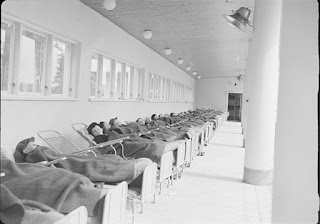

Children in a Sanatorium Finnish Museum of Photography, Public domain, via Wikimedia Commons

Sources

Letter, The West Australian, 20 December, 1906

Letter, The West Australian 23 September, 1908


Sunday, October 17, 2021

Would You Like To Buy An Unchanged Edwardian House?

 I am sure that the price of this Edwardian house, inhabited for a long time by an artist, will soar!

Sunday, January 31, 2021

The Long Struggle of the Shopgirls


‘Nine-tenths of the fallen women in London were once shop assistants,’ Lord Brabazon said in 1883. Denise, the heroine of Zola’s famous novel Au Bonheurs des Dames, certainly had a struggle to keep her morals intact, and not seek extra ‘employment’. Even when they were probably innocent of soliciting, shopgirls were looked down on as at least ‘cheap’.  In Zola’s novel, some of the bourgeois women think that the shopgirls are ‘all up for sale, the wretches, like their merchandise’.

Industrialization and imports from the colonies, such as India, saw the rapid growth in the amount and variety of goods coming from all over the world, including fine materials, exotic fruits and fancy china. Department stores and specialist shops sprung up throughout the country. Women began to enjoy shopping for leisure, and they preferred to be served by young women rather than men. Jessie Boucherett founded the Society for Promoting the Employment of Women to promote women shop assistants. ‘She asked pointedly, “Why should bearded men be employed to sell ribbon, lace, gloves, neck-kerchiefs, and the dozen other trifles to be found in a silk mercer's or haberdasher’s shop”?[i]

Many girls started to want independence, and a better career than being a servant. Being a shopgirl was increasingly regarded as ‘respectable,’ and they received better wages than servants. Shopkeepers preferred to employ girls and young women, because their wages were much lower than those of male shop assistants. The wages were usually two-thirds or even half the amount that their male counterparts received. It was also a cleaner and less physically demanding occupation than factory work.

Unfortunately, many girls who got jobs working in shops didn’t know what they were in for. Low wages were not their only problem. They often had to work incredibly long hours from early in the morning until late at night. Sometimes they worked until midnight on Saturday if they got Sunday off. Understandably, they were usually too tired to go to church on Sundays. The battle for a half-day on Saturday was a surprisingly long one. They also had to pay fines if they breached any of the numerous rules. Whiteleys had over 100 rules.

The shopgirls often had to live-in. This usually meant living in crowded dormitories with nasty food, which they often had to buy. Many received meagre breakfasts while they watched the shop managers and superior staff eating bacon and eggs. Margaret Blomfield, the first woman Cabinet minister in the UK, worked as a shopgirl when she was sixteen in a large draper’s shop in Brighton. She was incredibly unhappy, sleeping in a bare crowded dormitory, which was ‘incredibly hot in summer’ and ‘miserably cold in winter’. It was so difficult to get a bath that to get a hot bath once a week the girls had to run ‘at full speed for about half a mile’ to the public baths. Then they only had a quarter of an hour to undress, bathe and dress before the assistant ordered them out because the baths were about to close.[ii]

She was also incredibly scared when men knocked at the ground-floor windows, and tried to pull them down during Race Week. They had a struggle to slam and bolt the windows.

Margaret decided to join the Union, and spent time secretly observing conditions. She wrote about them as Grace Dare. Vaughan Nash used her reports in The Daily Chronicle, and they attracted the attention of Sir John Lubbock, who used them to improve living-in conditions in The Shop Assistant’s Act.

Conditions Improve

Even though the Coal Mine Act was passed in 1842, the first committee on shop conditions only reported toa Parliament forty years later. There were three committees, but nothing was done, because opposition remained strong for three main reasons. Many thought that the State shouldn’t interfere with working hours. Shopkeepers felt obliged to be at the mercy of the customer, and the need for profits was difficult and competitive. Also, shop assistants mostly didn’t want to join a union, because they felt that it was beneath them.[iii]

A few acts of Parliament improved conditions, but it wasn’t until the Shop Assistants Act of 1911 that a statutory half-day and a mandatory weekly holiday were introduced. The next two acts of 1912 and 1913 shortened the maximum weekly working hours, and made washing facilities mandatory in every shop.


[i] ‘Association for Promoting the Employment of Women’, English Woman’s Journal, vol.4, September 1859, p.57, quoted in Horn, Pamela and Annabel Hobley, Shopgirls, The True Story of Life Behind the Counter, Hutchinson, London, p.45


[ii] Horn, Pamela and Annabel Hobley, Shopgirls, The True Story of Life Behind the Counter, Hutchinson, London, p.90

[iii] Whitaker, Wilfred B. Victorian and Edwardian Shopworkers. The Struggle to Obtain Better Conditions and a Half-Holiday. David & Charles Newton Abbot, 1973, p.180


Tuesday, April 28, 2020

Spanish Flu in Australia

This terrible pandemic occurred well after the Edwardian era, but I thought that I'd include the link to my article anyway: Spanish Flu in Australia.

Monday, April 29, 2019

New Post Soon!

I am sorry that I have neglected this blog for so long. I hope to write a new post soon!

Monday, September 25, 2017

The Taglioni of the North.

Imperious and formidable, Katti Lanner was a famous ballerina, choreographer and dancing mistress who taught many English ballerinas in the late nineteenth and early twentieth century. Her career lasted until almost until she died at seventy-eight! Prima ballerina Phyllis Beddells recalled 77-year old Katti Lanner yelling at the corps de ballet if there was the slightest defect in their work or if they were out of line. Lanner didn't realise that she could be heard by the audience in the front.

Born in 1845 in Vienna, Lanner was the daughter of the great dancing teacher Josef Lanner. She began dancing at eight and trained at the Vienna Court Opera where she had lessons by Pietro Campilli and Isadore Carey. When she was 16, the young ballerina obtained her first starring role in the pas de deux in the ballet, Angelica. The great ballerinas Fanny Elssler and Fanny Cerritto were impressed with her dancing and Lanner was soon given more starring roles, for example, as Myrtha the Queen of the Wilis in Giselle in 1852. Famous Danish choreographer Bournonville chose her to play the leading role in the ballet Der Toreador.

After her beloved mother's and brother's deaths, Lanner decided to leave Vienna and went on to have a glittering career in Germany, where she was complimented by the King of Bavaria, New York and Lisbon, where the king gave her diamonds. She was nicknamed the 'Taglioni of the North' because of her similarity to the splendid Marie. She formed her own ballet company, taught ballet in Hamburg and produced ballets but she is known mainly for her ballets in England today.

Chosen to be the dancing mistress at the National School of Dancing in England when she was almost 50, Lanner settled in London with her husband Johann Geraldini and their three daughters, Sofia, Katharine and Albertina. Unfortunately, the marriage was not happy and he returned to Vienna. Apparently, Lanner preferred the Neapolitan dancer Giuseppe Venuto de Francesco and their relationship caused some scandal.

In the late 1880's, Lanner began teaching ballerinas and producing spectacular ballets at the Empire  Theatre in Leicester Square, such as Rose d'Amour about a fairy escaping a malignant elf who is rescued by Cupid. This included a Hungarian wedding dance and a Chinese dance of tea-flowers. At the end of the ballet, all the flowers were massed into a huge bouquet. The great C. Wilhelm's costume designs also featured in this ballet and several others.

Watching Cleopatra in 1889 must have been a delight! Maria Cavallazi starred and French composer Herve wrote the music for this amazing production. According to Ivor Guest, the spectacle was 'magnificent indeed, with the stage filled with a colourful throng of Roman soldiery, Nubian's, Egyptians and Greek slaves'. The Girl I Left Behind Me in 1893 about a young soldier who joined a Highland regiment in Burma also stunned audiences with its beautiful scenes. A critic in the Sketch called it 'a carnival of colour, of movement, of gaiety'.

One fun ballet that Lanner produced was Katrina in 1894. This featured ballerinas 'dressed up to represent cats in their nightly flings on the tiles' according to Pick-Me-Up magazine. The ballet starred Miss Ada Vincent as Princess Frou-Frou, a fairy cat, and Miss Lizzie Vincent as Tom Grey, a cat bridegroom.  You can view pictures of scenes from the ballet here and see why some of the critics were especially impressed by the cat costumes. Lanner loved cats herself - she had five of them!

Lanner died peacefully in 1908 on a Sunday morning at 9:00. She didn't know that her faithful dog predeceased her by a few hours. Many of her colleagues and her pupils attended her funeral and she is buried at West Norwood Cemetery.

Sunday, July 30, 2017

A Good Place To Meet Potential Husbands?

William R. Martin, the founder of men's clothing store Rogers, Peet & co, was concerned. He watched the hordes of young working women settling in New York and worried about their dismal lodgings and boarding houses. Where could these shopgirls and clerks find nice, suitable young men to marry?

He decided to build a residence on Hudson and West 12th streets which would provide them with respectable lodgings so that they could entertain 'desirable, young men' in the parlour, and he called it The Trowmart Inn after his son Trowbridge, who had tragically met an early death. Women who stayed at the inn had to meet certain conditions. They had to be under 35 and earn less than $15.00 per week. A bed in one of the 228 dorm-like rooms cost as little as 50 cents while a more private room could be obtained for $4.50 per week, including breakfast and dinner. The young women also had an ironing room on each floor and laundry was also provided. There were six parlours where the girls could entertain men and there was no curfew, but men were not allowed upstairs.  The young women also had a library and a full-time nurse was in attendance.  Dances were held three times a week.

Even though The Trowbridge Inn sounds as though it was nicely decorated with muslin curtains and solid antique oak furniture, there were many complaints about the small rooms.  One 21-year old office clerk told Munsey's Magazine that the Trowbridge and similar residences had narrow rooms with bad lighting and 'mincy wardrobes.'


Wednesday, June 7, 2017

Lemon Wax and Cameraderie in New York. Part One

(Katharine House, NYC, Wikimapia) 

Enza and Laura, two young ambitious seamstresses in The Shoemaker's Wife by Adriana Trigiani are delighted to find rooms at the relatively luxurious Milbank House in New York. This residence for single working women, Trigiani writes, was 'in the middle of a wide, tree-lined block of opulent homes, anchored by a lavish Episcoap church on the corner of Fifth Avenue and the charming Patchin Place houses across Sixth Avenue on the other, this block had character and whimsy, a rare combination in New York City at the turn of the progressive century.' This double brownstone with its formal library, parlour and 'deep garden' was a much nicer alternative to the many cheap and nasty lodgings which were the common lot of struggling girls away from home. I read that one shopgirl complained that there were 'six of us in the garret!' Milbank House was reasonably priced and breakfast and dinner were even included in the rent. . Enza loves her beautiful room bathed in sunlight at Milbank House with its fresh scent of lemon wax.

But 'more important than all these lovely features of gracious living,' according to Trigiani, ' was the camaraderie of the young residents, who aspired to better lives on the wings of their talent and creativity. Finally, Laura and Enza were with like-minded peers, who understood their feelings and drive'.

Milbank House, opened in 1919, was one of several houses run by the Ladies' Christian Union which decided to start building comfortable residences for single working women as far back as 1860  Seamstresses, shopgirls and factory workers were flocking to the city in search of better lives and they were often reduced to extremely poor living conditions and in serious danger of being compromised. Another house owned by the Ladies' Christian Union was Katharine House. This also had a library, a parlour and sewing machines for the residents.  There was even a relief fund to help the sick go to hospital and those who had trouble paying for meals.

Katharine House only closed in 2000.  According to a New York Times article in 1997, many of the women living there were extremely pleased to find it.  One ballerina had paid $600.00 a month for a 'rotten deal,' so she was amazed by the 'baby grand piano in the second-floor lounge, a terrace for summer socializing and maid service.' They didn't mind the rather Victorian rules - for example, men weren't allowed in the bedrooms and had to leave the beau parlours at 11;00 p.m.

You can read more about Katharine House here. (At first, it sounded rather good, but after reading Jeremiah's article and the comments, I am not so sure!)


Sunday, July 10, 2016

Bachelor Boys' Accommodation in Edwardian London

(A former Rowton House in Birmingham, Wikipedia) 

Although the majority of young and single working men lived with their families in the Edwardian age, several left home for the bigger cities, especially London.  Here, they often boarded in lodgings where they were provided with meals and perhaps cleaning.  They were not allowed to cook in their rooms.  Many of these lodgings were cheap and nasty, so philanthropists started to provide alternatives for these men.  Some of these sound even worse!

Rowton Houses were built by Lord Rowton, for example, so that men didn’t have to stay in squalid lodging houses.  Here, the young men paid a shilling for a cubicle, or a half and crown for a special which George Orwell in a later era described as ‘practically hotel accommodation’.  There were strict rules in these houses.  Cooking and playing cards were not allowed, and there was no entry before 7 p.m. and the boarders had to leave before 9:00 a.m. each day. Alcohol was forbidden and men could be punished for wetting their beds or other misbehaviours. Jack London who lived in the Tower House in East London in 1902 thought that it was packed with life that was ‘degrading and unwholesome,’ but George Orwell described the Rowton Houses as ‘splendid buildings’ and thought that they were better than the other available accommodation.

Sometimes, men who worked in particular occupations were actually provided with living quarters.  The London Road Fire Station in Manchester, opened in 1906, had flats for single men and families.  They were well-cared for, with a laundry, gymnasium, billiard room and a playroom for the children. This building with its sculptures by Milson seems to have been quite an enlightened idea for its time.
Wealthier single men, such as MP’s, often had pied a’ tierres in London in buildings like the ‘bright and charmingly decorated’ Marlborough Mansions with its coffee rooms.  There were usually servant’s quarters and meals were sent up from restaurants or kitchens. Mansion flats were very popular with their elegant rooms and maid and laundry service.

Jack Worthing in The Importance of Being Earnest lived in the luxurious Albany in London.  This was the haunt of aristocrats and the very wealthy. Lord Byron famously carried on his many affairs there in earlier times.  The Albany is the epitome of elegance with its high ceilings, large windows and light-filled rooms. Some of the occupants complained that their apartments were ‘cramped,’ however.  This would definitely have been my choice!


Monday, June 13, 2016

Eating Rice Pudding Under the Fig Tree. Bachelor Girl's Accommodation in London

Sah10406, The Mangle, Driscoll House, Wikipedia

Young teacher Molly Vivian (who later became the famous Molly Hughes) was tired of sharing cold mutton with her friend each night in their dreary London flat.  As soon as she became the head of training at Bedford College, she decided to move. She dreamed of 'being free of landladies and being able to eat our own rice pudding under our own fig tree!' She and her friend soon obtained accommodation in a Ladies' Residential Chamber nearby, but it didn't live up to this vision.

They found themselves in a top-floor flat with two rooms and a tiny kitchen/scullery.  They prepared their own breakfasts but shared dinner in the communal dining room. It couldn't have been much fun to go to the one bathroom on their floor on a cold night. Walking up the six flights of stairs must have been tiring as well! However, they did have their own keys so they did have some freedom and privacy. They had to pay a considerable rent for this uncomfortable-sounding accommodation, surprisingly.

Molly Vivian and her friend were just two of the many thousands of 'New Women' in the Edwardian era.  These single working women included professionals, such as teachers and librarians, and working-class women such as  typists and clerical workers.  There were increasing worries about these women having to live in nasty lodgings and falling into danger, so many organisations and philanthropists started to build suitable women's residences. These included the Chenies Street residence opened in 1889, Sloane Garden's House, Waterlow Court and the Ada Lewis House.

The Chenies Street Residential Chambers was built by the Ladies Dwelling Company, whose founders included the Garrett sisters, one of whom was the doctor, Elisabeth Garrett.
This consisted of purpose-built flats with two or three rooms, often with private bathrooms. It was intended for middle-class professional women and servant's quarters were added, so that they could hire help. Although there were gorgeous 'Persian tiles' in the dining room to inspire the young women, unfortunately, the cooking must have ruined the effect. There were so many complaints that the cooks had to be sent to classes! 

Waterlow Court in luxurious Hampstead would be my choice.  This consisted of fifty flats for professional women around a beautifully green English lawn.  There was also a central dining room here, as well as a common room and a kitchen.  A servant's hall and annex were added later.

Sloane Garden's House was another possibility.  This was made up of bed-sits with a shared kitchen or cubicles on the upper floors. There were also cleaning services and linen change.  The elegant building included a music room and a library. Unfortunately, according to Work and Leisure, the residence was not within the means of 'working gentlewomen with no fixed income'.

Ada Lewis House, founded by a wealthy Jewish philanthropist, was opened by Princess Louise of Argyll in 1913. This was more suitable for working women who could not afford high rents. This consisted mainly of single rooms with some double bedrooms.  There was also a sewing room, a library and a reading room.  The women could wash their clothes in the shared laundry and the drying room was famous for drying garments within a few hours. The decorations of the House also included colourful glazed tiles.

Although some of this accommodation sounds uncomfortable, the lives of young women had vastly improved since they lived at home until they got married.  Molly Vivian and her friend certainly enjoyed their new-found freedom!

I also intend to write a post about residences built for Edwardian bachelor girls in New York.


Tuesday, May 31, 2016

New Post Soon!

I am busy at the moment planning renovations but I hope to write a new post soon!

Tuesday, January 5, 2016

Wednesday, December 2, 2015

Edwardian Renaissance Style

An excellent article with some examples of splendid Edwardian architecture in London.

Thursday, November 12, 2015

Tuesday, November 10, 2015

Sunderland in Edwardian Times

Watch Edwardian scenes from 'Auld Sunderland' in North East England here.

Wednesday, September 9, 2015

Mother Passed Away Last Week

My beloved mother passed away last week. I may not feel like writing any blog posts for a while.

Saturday, July 4, 2015

Syrie and Mr Selfridge

Beaton, Cecil, Syrie Maugham, Wikipedia

One of my favourite shows on TV now is the costume drama "Mr Selfridge," based on the larger-than-life Harry Selfridge who founded the huge London department store Selfridges.  Selfridge introduced several great innovations, including placing the cosmetics section on the first floor and spectacular store windows.  One of these was a tribute to ballerina Anna Pavlova.  Unfortunately, even though the store-owner was married with four children, he enjoyed the company of women and gambling rather too much! Syrie Wellcome (later Maugham) was one of his many girlfriends.

Syrie Barnardo, born on July 10, 1879, had an extremely unhappy childhood.  Her father, who started Dr Barnado's homes for slum children in London's East End, kept strict control over the household.  He banned smoking and alcohol in his house, and he didn't even let the children go to the theatre.  He also liked them to read the Bible and 'good books'. 

The family home was quite luxurious, however, and the children went to expensive schools, so it wasn't all bad.  Syrie, who was a striking young woman, wanted to escape her restricted life, This probably caused her to marry the wealthy and much older pharmacist and businessman, Henry Wellcome when she was only 21.

There are many different stories about the marriage.  According to one, he beat her and he was generally very cruel, even making her ride camels in the Egyptian heat when she was pregnant.  He needed to travel for his business and Syrie often got sick.  They did have a son, who was probably dyslexic and physically delicate.  I have read that Henry Wellcome was kind to the son, supporting his decision to become a farmer.  This is hard to reconcile with the accusation of the beatings.

The marriage broke up after ten years but Wellcome didn't want a divorce.  Syrie could continue to mix in society in spite of the scandal because she was chaperoned by her widowed mother. Sophisticated and intelligent, she soon caught the eye of Harry Selfridge.  He even bought her a lovely house in Regent's Park and paid to have it lavishly furnished. She lived there with her mother.

Some people apparently thought that Syrie wasn't all that keen on Harry.  However, her friend Rebecca West wrote that it was 'certainly a love affair. But they were only lovers when it suited'.

Syrie eventually obtained a divorce from Wellcome because she was pregnant to gay writer, Somerset Maugham! She had a miscarriage but she later married him, two years after having his daughter Liza, named after the character in Maugham's novel, Liza of Lambeth.

Poor Syrie had no luck with the men, and Maugham was rotten to her and Liza, because he concentrated on his gay lovers.  She is still famous, however, because she began her own extremely fashionable interior design business frequented by clients, such as the Duchess of Windsor, and popularised the 'all-white' room.

Sunday, April 19, 2015

The Popular Australian Song Written in a Cemetery

Caroline wondered why the muse visited her at such strange times.  Nevertheless, she was thankful.  She had decided to enter the competition for a national song run by the Gawler Institute, but she had failed to find inspiration until today.  It was so peaceful here in the cemetery while she sat and watched her children play nearby that she took out her notebook and started to write...

The lyrics that Caroline Carleton composed that day won the competition in 1859, and it remained one of the most popular Australian songs for over 100 years, especially in Mrs Carleton's native state South Australia. The stirring music written by German immigrant Carl Linger helped convince the judges. "The Song of Australia" as even shortlisted for the National Anthem in 1977, but "Advance Australia Fair" won the day.  Some people still think that this is a pity.

Although not many people know of the song today, it played a small role in the moving love story of the tomboy Olive and Pat Dooley in the Australian series "Anzac Girls".  I especially enjoyed the scene in which Olive plays the song on the gramophone when she is conflicted about whether she should marry Pat!

Born near London in 1819, Caroline was well-educated, especially in languages and music. She spoke French and she played the piano and the harp.  Caroline married Charles James Carleton in 1836, and the couple migrated to Australia three years later with their two young children on the Prince Regent.  The two children died during the harsh voyage, but the couple had two more children. Charles Carleton was the ship's surgeon and worked as a medical officer in South Australia. Carleton died in 1861.

Caroline taught at private schools after her husband's death, but she also wrote poems and articles for newspapers. She died when she was only 54.

The song was one of famous singer Peter Dawson's favourite songs.  Here is a clip of him singing it:


Here are the lyrics:


THE SONG OF AUSTRALIAThere is a land where summer skies
Are gleaming with a thousand dyes,
Blending in witching harmonies, in harmonies;
And grassy knoll, and forest height,
Are flushing in the rosy light,
And all above is azure bright -
Australia!
There is a land where honey flows,
Where laughing corn luxuriant grows,
Land of the myrtle and the rose,
On hill and plain the clust'ring vine,
Is gushing out with purple wine,
And cups are quaffed to thee and thine -
Australia!
There is a land where treasures shine
Deep in the dark unfathomed mine,
For worshippers at Mammon's shrine,
Where gold lies hid, and rubies gleam,
And fabled wealth no more doth seem
The idle fancy of a dream -
Australia!
There is a land where homesteads peep
From sunny plain and woodland steep,
And love and joy bright vigils keep,
Where the glad voice of childish glee
Is mingling with the melody
Of nature's hidden minstrelsy -
Australia!
There is a land where, floating free,
From mountain top to girdling sea,
A proud flag waves exultingly,
And freedom's sons the banner bear,
No shackled slave can breathe the air,
Fairest of Britain's daughters fair -
Australia!